Change the surface
Regenerates
Mytocel MSK
Your own cartilage cells, prepared during the appointment and injected back into the joint. One session, nothing synthetic, nothing grown in a laboratory.
- From
- £3,000To confirm
- How long it lasts
- Builds over months from one session
- What is left behind
- Your own tissue
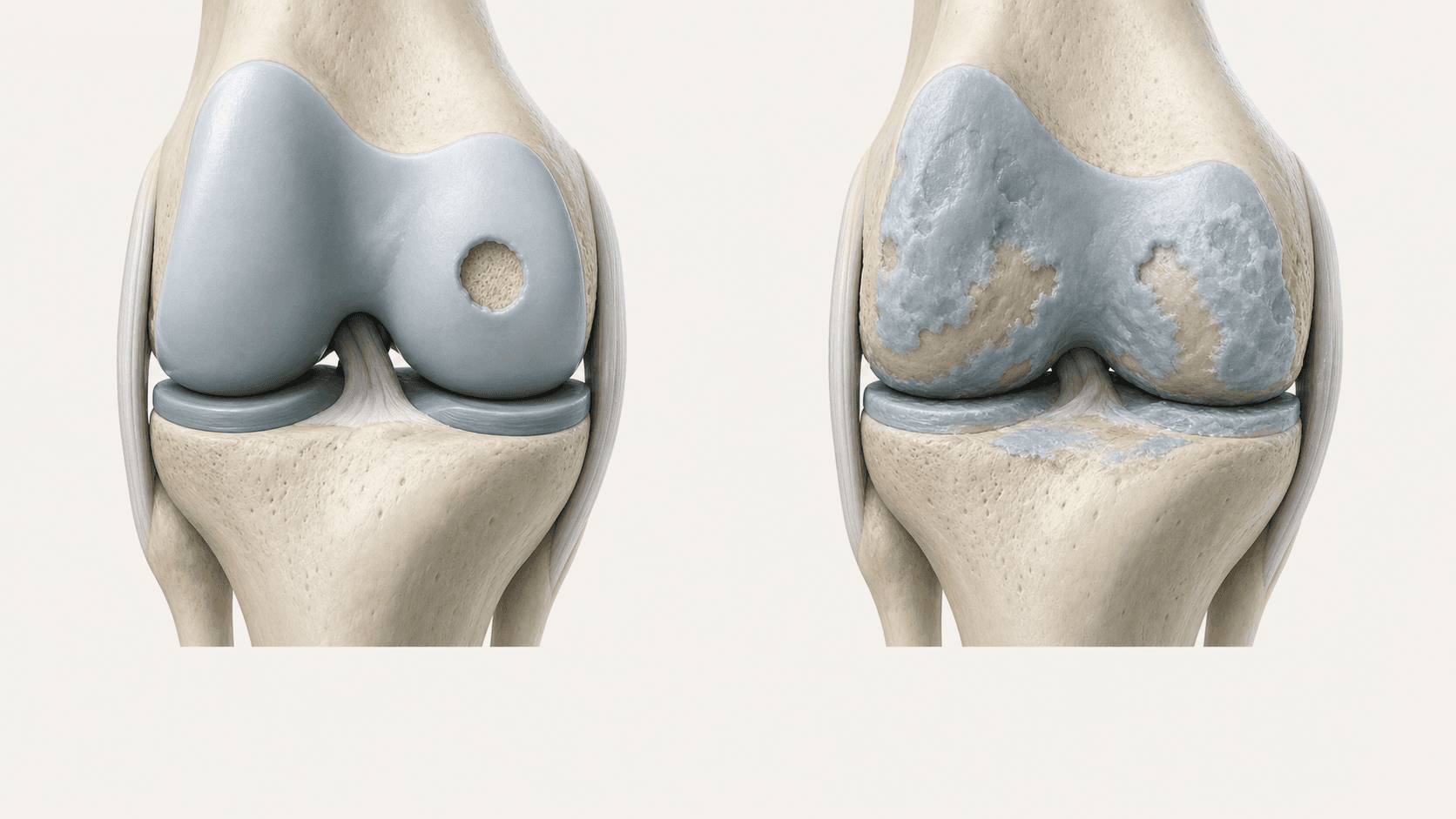
Where it sits
Mytocel MSK sits in the change the surface half of what we offer.
Works on the cartilage itself, aiming to rebuild or support it. Across the spectrum of wear, it may be considered from early wear to diffuse wear.
Best suited to earlier wear on its own. For more advanced wear it is used inside a fuller approach rather than by itself.
What it is
What it is
Mytocel MSK is an autologous micrograft injection. Autologous simply means it comes from you.
A small sample of your own cartilage is taken under local anaesthetic and processed at the chairside using the Regenera Activa micrografting system, which breaks it into tiny living micrografts rich in progenitor cells and their own natural matrix. Those micrografts are injected into the affected joint in the same appointment, which takes around thirty minutes in total.
Nothing is cultured in a laboratory, nothing is sent away, and nothing synthetic is introduced. You leave with your own tissue working inside the joint.
What it aims to do
What it does
- Delivers your own progenitor cells into the joint
- Aims to support the joint surface biologically rather than cushion it mechanically
- Completed in a single appointment, with no laboratory stage
What it does not do
- It does not regrow a joint that has lost its cartilage entirely
- It does not give instant pain relief, because it works over months
- On its own, it is not the right answer for advanced wear
Who it may suit
Who may be considered
- Earlier cartilage wear, where there is still cartilage to work with
- Soft-tissue problems around the joint as well as the surface itself
- The knee, and the thumb base, where it is used for rhizarthrosis
- People who would rather use their own tissue than a synthetic material
None of this replaces an assessment. Suitability is confirmed on examination and imaging, never from a web page.
When another fits better
When something else is the better answer
ChondroFiller Injection
For more advanced wear, or wear spread across the whole surface, a collagen scaffold covers more ground. This is the usual recommendation when the joint is past the early stage.
Arthrosamid
If what you actually want is reliable pain relief rather than biological repair, cushioning the joint may serve you better.
An assessment first
Imaging matters here. If your scan shows more damage than your symptoms suggest, the recommendation may well change.
The procedure
How it is done
- 01
Assessment and imaging
Examination and imaging confirm there is enough cartilage remaining for this approach to make sense.
- 02
Taking the sample
A small cartilage sample is taken under local anaesthetic. You are awake and comfortable throughout.
- 03
Chairside preparation
The sample is processed into micrografts in the room, during your appointment. Nothing leaves the clinic.
- 04
The injection
The micrografts are injected into the affected joint under image guidance, in the same visit.
Antibiotic cover is provided before treatment as part of the clinic infection-prevention protocol, alongside sterile technique.
Recovery
Recovery and what to expect
Most people return to light daily activity the same day. The whole appointment takes about thirty minutes.
Gentle activity and physiotherapy are encouraged over the following weeks. This is a biological process, so the change builds over months rather than arriving in days.
Mild joint inflammation in the first 24 to 48 hours is not unusual. Rest the joint for the first week, then build back gradually.

Risks
Risks and side effects
- Discomfort at the site the sample was taken from
- Mild joint inflammation in the first 24 to 48 hours
- Infection, which is rare but serious, and the reason for sterile technique and antibiotic cover
- A slower response than injections that work mechanically
- No benefit at all in a proportion of people
Evidence
What the evidence shows
The micrografting technology behind Mytocel MSK has peer-reviewed published data in knee cartilage problems, including a three-year follow-up study reporting increased cartilage thickness on MRI after a single application.
Limitations
Study populations are small and follow-up periods are relatively short by orthopaedic standards. Some of the available data is preliminary or presented at conference rather than peer-reviewed, and we label it as such. This is an emerging evidence base rather than a settled one.
Cartilage Micrografts as a Novel Non-Invasive and Non-Arthroscopic Autograft Procedure for Knee Chondropathy: Three-Year Follow-Up Study
Marcarelli M, Zappia M, Rissolio L, Baroni C, Astarita C, Trovato L, Graziano A.
A single application of autologous cartilage micrografts improved quality of life and increased cartilage thickness on MRI three years later.
View the published studyProspective Observational Study of a Non-Arthroscopic Autologous Cartilage Micrografting Technology for Knee Osteoarthritis
Tsoukas D, Muntean I, Simos C, Sabido-Vera R.
One intra-articular injection of auricular cartilage micrografts improved pain and function in early-to-moderate knee osteoarthritis.
View the published studyPrice
What it costs, and where
Included
£3,000To confirm
- Consultation
- Tissue sample and preparation
- Image-guided delivery
Charged separately: imaging
Compare
How it compares with the other three
Descriptive, not a ranking. Each of these does a different job.
| Hyaluronic acid | Arthrosamid® | Mytocel MSK | ChondroFiller Injection® | |
|---|---|---|---|---|
| What it does | Lubricates | Cushions | Regenerates | Rebuilds |
| Main purpose | Lubrication and symptom relief | Longer-term symptom management | Autologous regenerative pathway | Collagen scaffold across worn surfaces |
| Type | Manage the symptoms | Manage the symptoms | Change the surface | Change the surface |
| Pattern of wear | early wear to diffuse wear | early wear to bone on bone | early wear to diffuse wear | early wear to bone on bone |
| How long it lasts | Around six months | Several years from one injection | Builds over months from one session | Builds over six to twelve months |
| What is left behind | Absorbed by the body | Stays in the joint, not absorbed | Your own tissue | Resorbs, leaving your own tissue |
| Joints | Knee, Hip, Shoulder | Knee | Knee, Thumb base | Knee, Hip, Shoulder, Ankle, Elbow, Hand, Wrist |
| Important limitation | The usual first step, and the shortest acting of the four. | Acting early suits it well. At bone on bone it eases pain but changes nothing structurally. | Best suited to earlier wear on its own. For more advanced wear it is used inside a fuller approach rather than by itself. | The widest range of the four. At bone on bone it is usually combined with another treatment, or weighed against replacement. |
| From | £600To confirm | £2,400To confirm | £3,000To confirm | £3,500To confirm |
Manage the symptoms
Hyaluronic acid
- What it does
- Lubricates
- Main purpose
- Lubrication and symptom relief
- Pattern of wear
- early wear to diffuse wear
- How long it lasts
- Around six months
- What is left behind
- Absorbed by the body
- Joints
- Knee, Hip, Shoulder
- Important limitation
- The usual first step, and the shortest acting of the four.
- From
- £600To confirm
Manage the symptoms
Arthrosamid®
- What it does
- Cushions
- Main purpose
- Longer-term symptom management
- Pattern of wear
- early wear to bone on bone
- How long it lasts
- Several years from one injection
- What is left behind
- Stays in the joint, not absorbed
- Joints
- Knee
- Important limitation
- Acting early suits it well. At bone on bone it eases pain but changes nothing structurally.
- From
- £2,400To confirm
Change the surface
Mytocel MSK
- What it does
- Regenerates
- Main purpose
- Autologous regenerative pathway
- Pattern of wear
- early wear to diffuse wear
- How long it lasts
- Builds over months from one session
- What is left behind
- Your own tissue
- Joints
- Knee, Thumb base
- Important limitation
- Best suited to earlier wear on its own. For more advanced wear it is used inside a fuller approach rather than by itself.
- From
- £3,000To confirm
Change the surface
ChondroFiller Injection®
- What it does
- Rebuilds
- Main purpose
- Collagen scaffold across worn surfaces
- Pattern of wear
- early wear to bone on bone
- How long it lasts
- Builds over six to twelve months
- What is left behind
- Resorbs, leaving your own tissue
- Joints
- Knee, Hip, Shoulder, Ankle, Elbow, Hand, Wrist
- Important limitation
- The widest range of the four. At bone on bone it is usually combined with another treatment, or weighed against replacement.
- From
- £3,500To confirm
This comparison describes what each treatment is for. It is not a ranking, and it cannot tell you which one suits your joint. That is decided at assessment, on examination and imaging.
Questions
Common questions
- Is this stem cell treatment?
- It is not cultured stem cell therapy. Your own tissue is processed mechanically at the chairside into micrografts and used the same day. Nothing is grown or expanded in a laboratory.
- How long does the appointment take?
- Around thirty minutes from sample to injection, in one visit.
- When will I notice a difference?
- This works over months, not days. It is not the right choice if you need relief quickly.
- Why is it not recommended for a very worn joint?
- It works with the cartilage you still have. Where very little remains, a scaffold approach such as ChondroFiller Injection generally makes more sense, and we will say so.
Other treatments
Find out whether Mytocel MSK fits your joint.
An assessment looks at the joint, the imaging and what you want back, then tells you honestly which of the four fits, or whether none of them does.