Condition
Cartilage damage
Damage to the joint surface itself, often after an injury rather than from age. Cartilage cannot repair itself, which is what makes the pattern of damage worth establishing properly.
This page explains the condition. It does not recommend a treatment, because that depends on your joint rather than your diagnosis label.
In plain English
What is actually happening
Cartilage has no blood supply and no nerve supply. That combination explains a great deal: it cannot heal itself the way skin or bone can, and damage to it is not directly painful.
Damage can be an injury, a twist or an impact that takes a piece out of the surface, or it can be gradual wear. It can also follow surgery elsewhere in the joint. Removing a meniscus, for example, concentrates load onto cartilage never designed to absorb it, and osteoarthritis commonly follows within five to twelve years.
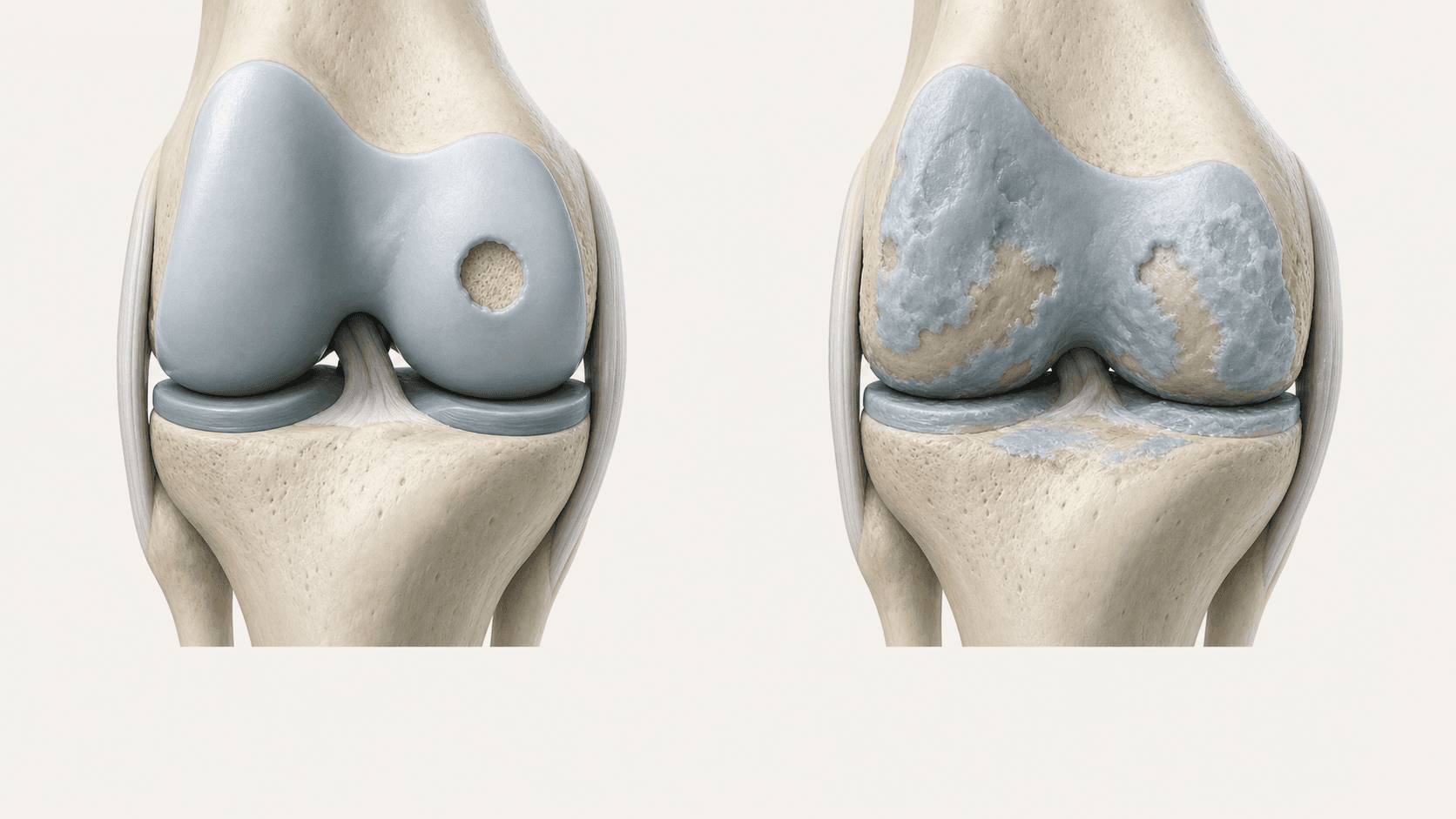
What matters clinically is not just that there is damage, but its shape: one contained area, or wear spread across the whole surface. Those two pictures suit different treatments.
Common symptoms
What people usually describe
You will not have all of these, and having them does not confirm the diagnosis.
Pain in one specific spot
Often localised rather than a general ache through the whole joint.
Swelling after activity
The joint reacts to load, then settles with rest.
Catching or clicking
A sensation of something snagging inside the joint as it moves.
Pain that followed an injury
A twist, an impact or a sporting incident that the joint never quite recovered from.
Worse on impact
Running, jumping and stairs hurt more than flat walking.
Confidence in the joint
Avoiding certain movements, even without genuine instability.
Or is it something else
How this differs from similar problems
Generalised morning stiffness
Stiffness across the whole joint that eases as you move usually points at osteoarthritis rather than a discrete cartilage defect.
True locking
A joint that genuinely locks in position may have a loose fragment or a meniscal tear, and needs assessing before any injection is considered.
Pain around the joint, not inside it
Tendon and ligament problems sit outside the joint and behave differently. They are a different treatment conversation.
Imaging
What imaging adds
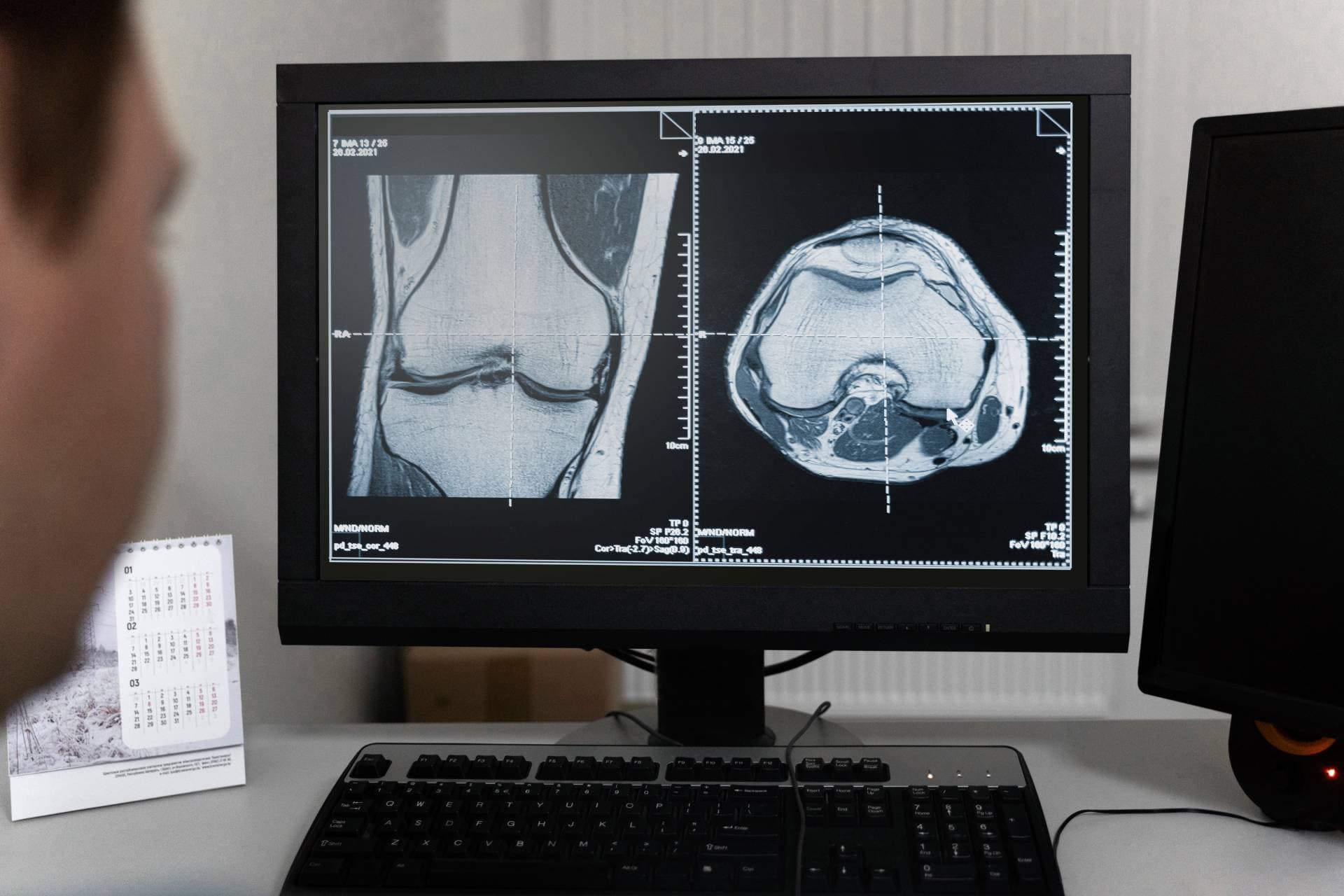
MRI is what shows cartilage. It maps where the damage is, how deep it goes, and whether the bone underneath is involved.
This is the point of the scan for cartilage damage: it distinguishes one contained defect from broad surface wear. Those look similar from the outside and are not treated the same way.
It also shows whether the rest of the joint is mechanically sound. A treatment that works on the surface will not hold up in a joint that is unstable or badly aligned, and knowing that beforehand prevents a wasted procedure.

Where it sits
On the spectrum of wear
Cartilage damage can sit anywhere on this range, and the pattern matters more than the label.
What may be discussed
Treatments that tend to come up
Not a recommendation. These are the options a doctor may raise for this condition, and which one fits is decided on examination and imaging.
Rebuilds
ChondroFiller Injection®
A collagen scaffold for your own cells to rebuild into. Works for a contained defect and for broader surface wear.
Regenerates
Mytocel MSK
Your own cartilage cells, where wear is still early and there is enough tissue to work with.
Lubricates
Hyaluronic acid
Not structural, but it can make a damaged joint more comfortable to live with and move on.
Possibly none of them
An assessment first
Where the joint is mechanically unsound, that has to be dealt with before any surface treatment makes sense.
Book an assessmentLimits
When an injection is not enough
We offer four injections and nothing else. These are the situations where the honest answer sits outside them.
- The joint is unstable, or a ligament is not doing its job
- There is a loose fragment or a meniscal tear causing true locking
- Significant malalignment is driving load onto the damaged area
- The damage is extensive and the joint has effectively run out of surface
Urgent
When to seek help sooner
These are not injection-clinic problems. If any apply, contact your GP, NHS 111 or an emergency department rather than booking with us.
- A joint locked in position that you cannot straighten
- Sudden giving way that causes falls
- A hot, swollen joint with fever, which needs urgent assessment
- Severe pain immediately after an injury, with inability to weight-bear
Questions
Common questions
- Can cartilage repair itself?
- Not meaningfully. It has no blood supply, which is exactly why treatments in this area focus on giving your own cells a structure or a starting point to work from.
- Does the size of the defect decide whether I can be treated?
- Less than people expect. Candidacy depends more on whether the joint environment can support a repair response than on the size of the defect or your age.
- I had a meniscus removed years ago and my knee hurts now. Is that related?
- Very possibly. The meniscus spreads a large share of the load across the knee, and once it is gone that force concentrates onto cartilage that was not built for it.
- Which joints can be treated?
- Cartilage damage is treatable across many joints, including the knee, hip, ankle, shoulder, elbow, wrist, hand and thumb. Which of our four treatments is available for your joint is confirmed at assessment.
Related
Find out what your joint actually needs.
An assessment looks at the joint, your imaging and what you want back, then tells you which of the four fits, or whether none of them does.