Change the surface
Rebuilds
ChondroFiller® Injection
A collagen scaffold laid across worn joint surfaces by injection. No keyhole surgery, no incision, no general anaesthetic. The scaffold is absorbed and your own tissue is what remains.
- From
- £3,500To confirm
- How long it lasts
- Builds over six to twelve months
- What is left behind
- Resorbs, leaving your own tissue
Where it sits
ChondroFiller Injection sits in the change the surface half of what we offer.
Works on the cartilage itself, aiming to rebuild or support it. Across the spectrum of wear, it may be considered from early wear to bone on bone.
The widest range of the four. At bone on bone it is usually combined with another treatment, or weighed against replacement.
What it is
What it is, and how our protocol differs
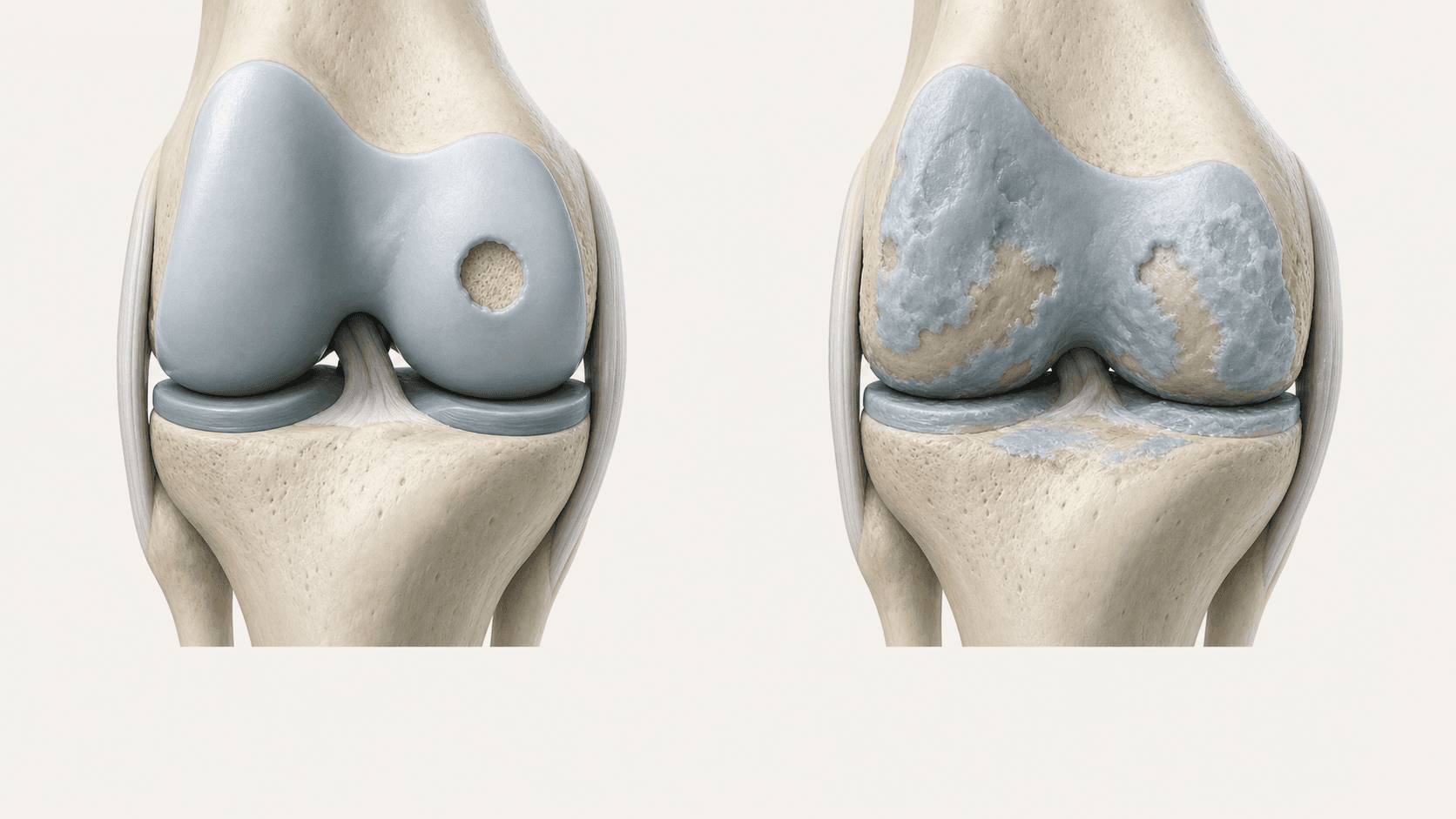
ChondroFiller is an acellular collagen gel. Acellular means it contains no cells: it is a structure, not a biological product. Injected into the joint, it sets in place within minutes and forms a matrix that supports your own cells in rebuilding tissue within it. Over time the scaffold is absorbed and what remains is your own tissue.
Conventionally, ChondroFiller is placed into a single prepared cartilage defect during a surgical or arthroscopic procedure. That is not what happens here.
The AMSK protocol is a non-surgical ChondroFiller Injection, delivered as a single ultrasound-guided injection in clinic. There is no keyhole surgery, no incision and no general anaesthetic. Rather than filling one contained hole, it aims to lay a collagen scaffold across worn joint surfaces. That widens the range of cases that can be assessed, from one focal defect to wear spread across the whole joint.
The non-surgical ChondroFiller Injection protocol was pioneered by Professor Paul Y. F. Lee and is delivered through the AMSK doctor network using a standardised clinical pathway.
What it aims to do
What it does
- Lays a collagen scaffold across the worn surface
- Supports your own cells in rebuilding tissue within it
- Delivered by injection in clinic, without surgery
- Applies from one contained defect through to diffuse whole-joint wear
What it does not do
- It is not a guarantee of new cartilage, and outcomes vary between individuals
- It does not work quickly, building over six to twelve months
- It does not correct a mechanical problem such as instability or malalignment
- It is not automatically the right answer for a bone-on-bone joint
Who it may suit
Who may be considered
- One contained area of cartilage damage, a focal defect
- Wear spread diffusely across the joint surface
- The knee, hip, shoulder, ankle, elbow, hand and wrist
- People who want to work on the joint surface without surgery
- Advanced and bone-on-bone wear is not an automatic exclusion from assessment, though it is not automatically suitable either
None of this replaces an assessment. Suitability is confirmed on examination and imaging, never from a web page.
When another fits better
When something else is the better answer
Mytocel MSK
Where wear is still early and the priority is using your own tissue, a micrograft approach may be the more proportionate step.
Arthrosamid
If reliable pain relief matters more to you than structural work. At more advanced wear the two are sometimes used together.
A joint replacement
In a severely worn joint, replacement is the more definitive option, and it should be weighed honestly rather than dismissed.
The procedure
How it is done
- 01
Imaging first
A recent scan, typically an MRI, maps the extent and pattern of the wear. This is what the treatment plan is built on, and it is why we ask for it before confirming anything.
- 02
Assessment
A doctor examines the joint, reviews the imaging and confirms whether the scaffold approach fits. Joint mechanics, instability, alignment, general health and your expectations all affect that answer.
- 03
The injection
A single ultrasound-guided injection in an outpatient appointment of around 30 to 45 minutes. The gel sets in place within minutes. No incision and no general anaesthetic.
- 04
Follow-up
A clinical review to assess how the joint is responding as tissue establishes within the scaffold.
Antibiotic cover is provided before treatment as part of the clinic infection-prevention protocol, alongside sterile technique.
Recovery
Recovery and what to expect
Most people return to desk work the same day. This is activity modification rather than immobilisation: you are not in a brace and you are not on crutches.
High-impact activity is paused for two to four weeks. Physiotherapy is encouraged and helps, though it is arranged separately.
Most people begin to notice improvement between six and twelve weeks, with benefit continuing to build over six to twelve months as tissue establishes within the scaffold. If you need relief next week, this is not the treatment for that.

Risks
Risks and side effects
- Temporary pain, swelling or stiffness after the injection
- Infection, which is rare but serious, and the reason for sterile technique and antibiotic cover
- A slower response than treatments that work mechanically
- The result depends on your own biology, so outcomes vary between individuals
- No benefit at all in a proportion of people
Evidence
What the evidence shows
ChondroFiller is a CE-marked medical device with a substantial safety record across many thousands of treated cases, and published data reporting improvement in joint function sustained over several years.
Limitations
Much of the published data relates to the conventional surgical application rather than to the non-surgical injection protocol used here. Evidence for the injected protocol in diffuse and advanced wear is less mature, and we would rather state that than imply the two are interchangeable. A CE mark is a regulatory approval, not an endorsement of effectiveness.
Price
What it costs, and where
Included
£3,500To confirm
- Consultation
- Ultrasound-guided injection
- One follow-up review
Charged separately: imaging
Compare
How it compares with the other three
Descriptive, not a ranking. Each of these does a different job.
| Hyaluronic acid | Arthrosamid® | Mytocel MSK | ChondroFiller Injection® | |
|---|---|---|---|---|
| What it does | Lubricates | Cushions | Regenerates | Rebuilds |
| Main purpose | Lubrication and symptom relief | Longer-term symptom management | Autologous regenerative pathway | Collagen scaffold across worn surfaces |
| Type | Manage the symptoms | Manage the symptoms | Change the surface | Change the surface |
| Pattern of wear | early wear to diffuse wear | early wear to bone on bone | early wear to diffuse wear | early wear to bone on bone |
| How long it lasts | Around six months | Several years from one injection | Builds over months from one session | Builds over six to twelve months |
| What is left behind | Absorbed by the body | Stays in the joint, not absorbed | Your own tissue | Resorbs, leaving your own tissue |
| Joints | Knee, Hip, Shoulder | Knee | Knee, Thumb base | Knee, Hip, Shoulder, Ankle, Elbow, Hand, Wrist |
| Important limitation | The usual first step, and the shortest acting of the four. | Acting early suits it well. At bone on bone it eases pain but changes nothing structurally. | Best suited to earlier wear on its own. For more advanced wear it is used inside a fuller approach rather than by itself. | The widest range of the four. At bone on bone it is usually combined with another treatment, or weighed against replacement. |
| From | £600To confirm | £2,400To confirm | £3,000To confirm | £3,500To confirm |
Manage the symptoms
Hyaluronic acid
- What it does
- Lubricates
- Main purpose
- Lubrication and symptom relief
- Pattern of wear
- early wear to diffuse wear
- How long it lasts
- Around six months
- What is left behind
- Absorbed by the body
- Joints
- Knee, Hip, Shoulder
- Important limitation
- The usual first step, and the shortest acting of the four.
- From
- £600To confirm
Manage the symptoms
Arthrosamid®
- What it does
- Cushions
- Main purpose
- Longer-term symptom management
- Pattern of wear
- early wear to bone on bone
- How long it lasts
- Several years from one injection
- What is left behind
- Stays in the joint, not absorbed
- Joints
- Knee
- Important limitation
- Acting early suits it well. At bone on bone it eases pain but changes nothing structurally.
- From
- £2,400To confirm
Change the surface
Mytocel MSK
- What it does
- Regenerates
- Main purpose
- Autologous regenerative pathway
- Pattern of wear
- early wear to diffuse wear
- How long it lasts
- Builds over months from one session
- What is left behind
- Your own tissue
- Joints
- Knee, Thumb base
- Important limitation
- Best suited to earlier wear on its own. For more advanced wear it is used inside a fuller approach rather than by itself.
- From
- £3,000To confirm
Change the surface
ChondroFiller Injection®
- What it does
- Rebuilds
- Main purpose
- Collagen scaffold across worn surfaces
- Pattern of wear
- early wear to bone on bone
- How long it lasts
- Builds over six to twelve months
- What is left behind
- Resorbs, leaving your own tissue
- Joints
- Knee, Hip, Shoulder, Ankle, Elbow, Hand, Wrist
- Important limitation
- The widest range of the four. At bone on bone it is usually combined with another treatment, or weighed against replacement.
- From
- £3,500To confirm
This comparison describes what each treatment is for. It is not a ranking, and it cannot tell you which one suits your joint. That is decided at assessment, on examination and imaging.
Questions
Common questions
- Is this the same as the surgical ChondroFiller procedure?
- No, and the difference matters. Conventional use places the scaffold into a prepared defect during keyhole surgery. Our protocol delivers it by ultrasound-guided injection in clinic, with no incision and no general anaesthetic.
- Is it the same as Liquid Cartilage?
- No. Liquid Cartilage is a surgical pathway offered elsewhere in the group. What we offer is the non-surgical injection protocol.
- Will it regrow my cartilage?
- It aims to support your own cells in rebuilding tissue within the scaffold. It is not a guarantee of new cartilage, and how much you get depends on your own biology and the state of the joint.
- I have been told I am bone on bone. Am I excluded?
- Not automatically excluded from assessment. But nor is it automatically suitable, and at that stage a joint replacement genuinely deserves discussing alongside it. An honest assessment is the only way to answer this.
- Do I need an MRI first?
- Usually, yes. The plan is built on what the scan shows, and a scan more than a year old often needs repeating.
- How long until I notice anything?
- Six to twelve weeks before most people notice a change, building over six to twelve months.
Other treatments
Find out whether ChondroFiller Injection fits your joint.
An assessment looks at the joint, the imaging and what you want back, then tells you honestly which of the four fits, or whether none of them does.