Manage the symptoms
Lubricates
Hyaluronic acid
A lubricating injection that reduces friction inside a worn joint. Well established, straightforward, and the lowest-cost of the four treatments we offer.
- From
- £600To confirm
- How long it lasts
- Around six months
- What is left behind
- Absorbed by the body
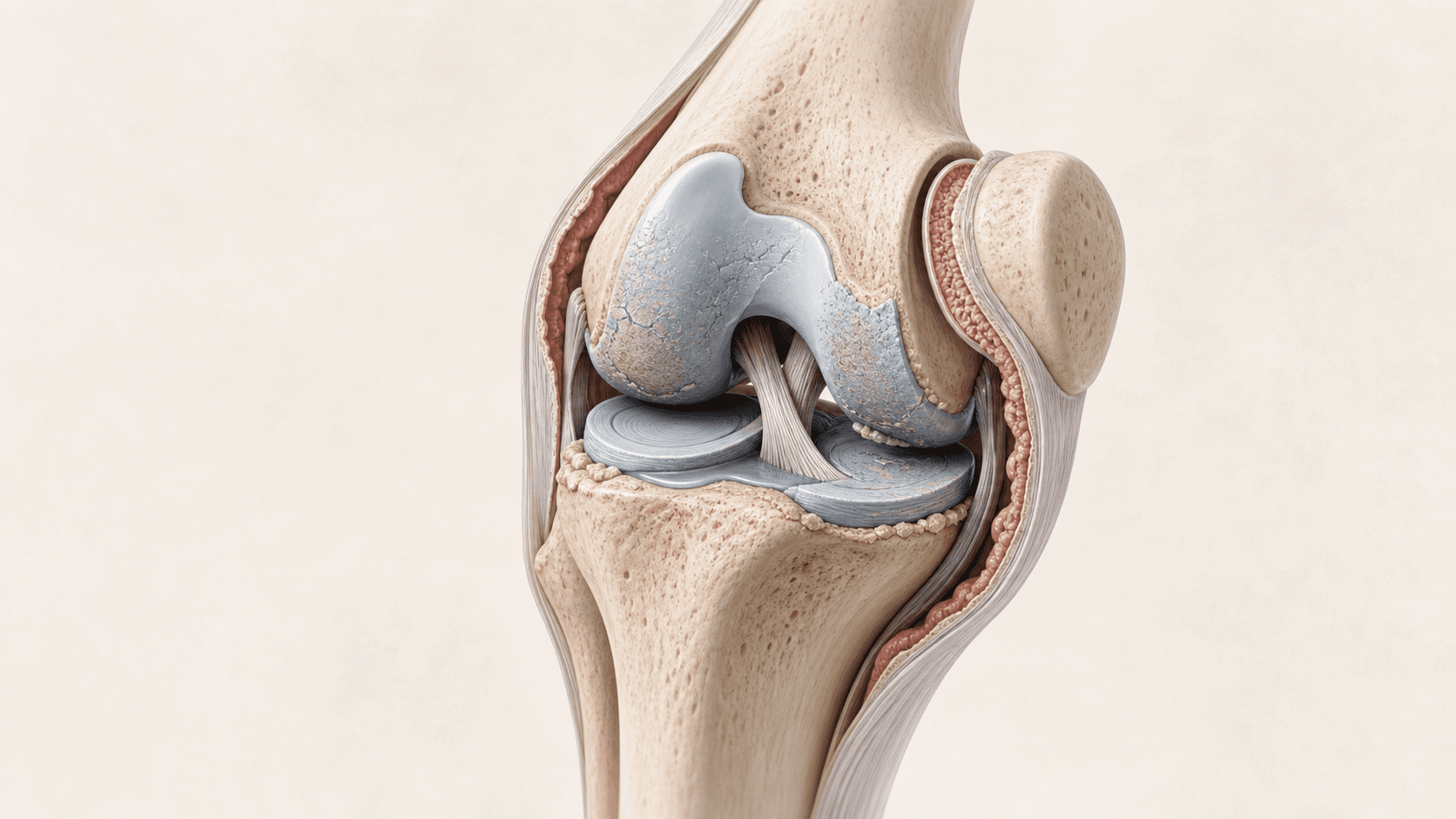
Where it sits
Hyaluronic acid sits in the manage the symptoms half of what we offer.
Treats how the joint feels. The surface itself is left as it is. Across the spectrum of wear, it may be considered from early wear to diffuse wear.
The usual first step, and the shortest acting of the four.
What it is
What it is
Hyaluronic acid occurs naturally in the fluid inside your joints, where it acts as a lubricant and a shock absorber. In an osteoarthritic joint, that fluid thins and loses much of its cushioning quality.
A hyaluronic acid injection, sometimes called viscosupplementation, tops that fluid back up. It is delivered directly into the joint, usually under ultrasound guidance so it goes exactly where it is needed. It is available as a single injection or as a course, depending on the preparation used.
What it aims to do
What it does
- Reduces friction between the joint surfaces
- Eases day-to-day pain and stiffness
- Can make movement and exercise more comfortable, which helps everything else
What it does not do
- It does not rebuild or repair cartilage
- It does not stop osteoarthritis progressing
- It is not permanent, and is absorbed by the body over months
Who it may suit
Who may be considered
- Early to moderate osteoarthritis, where the joint is worn but not severely so
- People who want to try the least invasive and least expensive option first
- People for whom anti-inflammatory medication is unsuitable or has stopped helping
- Joints including the knee, hip and shoulder
None of this replaces an assessment. Suitability is confirmed on examination and imaging, never from a web page.
When another fits better
When something else is the better answer
Arthrosamid
If you do not want to keep repeating injections. Arthrosamid stays in the joint and is expected to last years rather than months.
ChondroFiller Injection
If the goal is to support the worn surface itself rather than to lubricate around it.
An assessment first
If the joint locks, catches or gives way, which points to something mechanical that no injection addresses.
The procedure
How it is done
- 01
Assessment
A doctor examines the joint and reviews any imaging you already have, to confirm the pattern of wear and that an injection is reasonable.
- 02
Preparation
An outpatient appointment. No fasting, no general anaesthetic, and you can drive yourself in.
- 03
The injection
The joint is cleaned and the injection placed into the joint space, usually with ultrasound guidance to confirm position.
- 04
Straight afterwards
You walk out the same day. Most people go back to normal activity almost immediately.
Antibiotic cover is provided before treatment as part of the clinic infection-prevention protocol, alongside sterile technique.
Recovery
Recovery and what to expect
Most people are back to normal activity the same day, with a short period of taking it easy on the joint.
Relief is not instant. Hyaluronic acid typically takes a few weeks to take full effect, and relief then lasts around six months. Some people get longer, some shorter, and some notice very little difference at all.
It can be repeated. If it worked well the first time, repeating it is reasonable. If it did not help at all, repeating it usually is not the answer, and that is worth saying at your review.

Risks
Risks and side effects
- Temporary pain, swelling or warmth in the joint for a day or two afterwards
- A small flare in the first 24 to 48 hours
- Infection, which is rare but serious, and the reason for sterile technique and antibiotic cover
- No benefit at all in a proportion of people
Evidence
What the evidence shows
Hyaluronic acid is one of the most studied injections in osteoarthritis, with decades of clinical use behind it. The consistent finding is modest pain relief over a period of months in mild to moderate disease.
Limitations
The evidence is mixed rather than uniformly positive, and national guidance in some countries does not recommend it routinely. Benefit varies a lot between individuals, and it is less likely to help in a severely worn joint. We would rather say that plainly than oversell it.
Price
What it costs, and where
Included
£600To confirm
- Consultation
- Ultrasound-guided injection
- One follow-up review
Charged separately: imaging
Available at
SleafordTo confirm
London Road, Silk Willoughby, Sleaford, NG34 8NY
GranthamTo confirm
The Old Barracks, Sandon Road, Grantham, NG31 9AS
Compare
How it compares with the other three
Descriptive, not a ranking. Each of these does a different job.
| Hyaluronic acid | Arthrosamid® | Mytocel MSK | ChondroFiller Injection® | |
|---|---|---|---|---|
| What it does | Lubricates | Cushions | Regenerates | Rebuilds |
| Main purpose | Lubrication and symptom relief | Longer-term symptom management | Autologous regenerative pathway | Collagen scaffold across worn surfaces |
| Type | Manage the symptoms | Manage the symptoms | Change the surface | Change the surface |
| Pattern of wear | early wear to diffuse wear | early wear to bone on bone | early wear to diffuse wear | early wear to bone on bone |
| How long it lasts | Around six months | Several years from one injection | Builds over months from one session | Builds over six to twelve months |
| What is left behind | Absorbed by the body | Stays in the joint, not absorbed | Your own tissue | Resorbs, leaving your own tissue |
| Joints | Knee, Hip, Shoulder | Knee | Knee, Thumb base | Knee, Hip, Shoulder, Ankle, Elbow, Hand, Wrist |
| Important limitation | The usual first step, and the shortest acting of the four. | Acting early suits it well. At bone on bone it eases pain but changes nothing structurally. | Best suited to earlier wear on its own. For more advanced wear it is used inside a fuller approach rather than by itself. | The widest range of the four. At bone on bone it is usually combined with another treatment, or weighed against replacement. |
| From | £600To confirm | £2,400To confirm | £3,000To confirm | £3,500To confirm |
Manage the symptoms
Hyaluronic acid
- What it does
- Lubricates
- Main purpose
- Lubrication and symptom relief
- Pattern of wear
- early wear to diffuse wear
- How long it lasts
- Around six months
- What is left behind
- Absorbed by the body
- Joints
- Knee, Hip, Shoulder
- Important limitation
- The usual first step, and the shortest acting of the four.
- From
- £600To confirm
Manage the symptoms
Arthrosamid®
- What it does
- Cushions
- Main purpose
- Longer-term symptom management
- Pattern of wear
- early wear to bone on bone
- How long it lasts
- Several years from one injection
- What is left behind
- Stays in the joint, not absorbed
- Joints
- Knee
- Important limitation
- Acting early suits it well. At bone on bone it eases pain but changes nothing structurally.
- From
- £2,400To confirm
Change the surface
Mytocel MSK
- What it does
- Regenerates
- Main purpose
- Autologous regenerative pathway
- Pattern of wear
- early wear to diffuse wear
- How long it lasts
- Builds over months from one session
- What is left behind
- Your own tissue
- Joints
- Knee, Thumb base
- Important limitation
- Best suited to earlier wear on its own. For more advanced wear it is used inside a fuller approach rather than by itself.
- From
- £3,000To confirm
Change the surface
ChondroFiller Injection®
- What it does
- Rebuilds
- Main purpose
- Collagen scaffold across worn surfaces
- Pattern of wear
- early wear to bone on bone
- How long it lasts
- Builds over six to twelve months
- What is left behind
- Resorbs, leaving your own tissue
- Joints
- Knee, Hip, Shoulder, Ankle, Elbow, Hand, Wrist
- Important limitation
- The widest range of the four. At bone on bone it is usually combined with another treatment, or weighed against replacement.
- From
- £3,500To confirm
This comparison describes what each treatment is for. It is not a ranking, and it cannot tell you which one suits your joint. That is decided at assessment, on examination and imaging.
Questions
Common questions
- How long does it last?
- Typically around six months. It varies between people, and it tends to give less in a more worn joint.
- How soon will I feel something?
- Usually a few weeks rather than a few days. If you need faster relief, say so at your assessment, because a different approach may suit you better.
- Can I have it more than once?
- Yes, if it helped. If it did nothing the first time, repeating it is not usually the right recommendation.
- Is it the same as a steroid injection?
- No. A steroid injection settles inflammation quickly but fades within weeks. Hyaluronic acid works on lubrication and takes longer to build, but lasts longer.
Other treatments
Find out whether Hyaluronic acid fits your joint.
An assessment looks at the joint, the imaging and what you want back, then tells you honestly which of the four fits, or whether none of them does.